
More from the 60 per cent Spanish companies do not achieve optimal results with their digital campaigns due to errors in defining objectives and audience.
Understand who your audience is and where you want them to go. direct your efforts is the starting point for any successful strategy. Here you will find out how to avoid the most common mistakes and focus every step of your digital campaign to achieve real results and measurable.
Quick summary
| Key Point | Explanation |
|---|---|
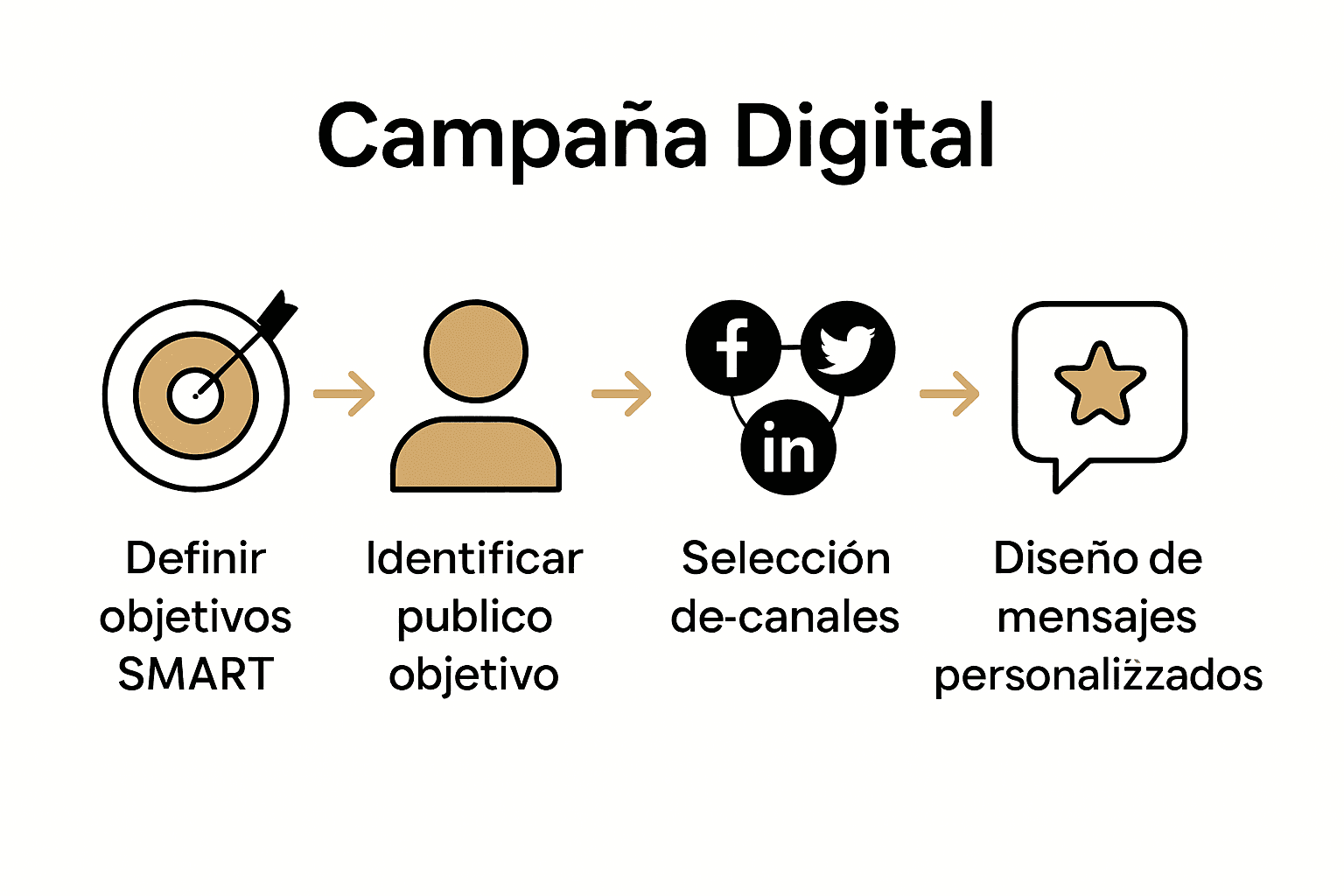
| 1. Define clear objectives | Set specific and measurable goals using the SMART methodology to guide your campaign. |
| 2. Know your target audience | Perform a detailed analysis and create customer profiles to personalise your messages. |
| 3. Select appropriate channels | Prioritise platforms where your audience is active, tailoring your content to each one. |
| 4. Design personalised messages | Connect emotionally with your audience using relevant messages and creative content. |
| 5. Measure and optimise results | Use key metrics to evaluate the performance and make continuous adjustments to your strategy. |
Step 1: Define your campaign's objectives and target audience
The precise definition of objectives and target audience is the foundation of any successful digital campaign for businesses in Spain. This first step will determine the entire strategy and establish the framework for all the digital marketing actions you will carry out.
To define your campaign objectives, you need to be specific and measurable. It is not enough to say “I want to sell more”. Instead, you should set concrete goals such as “increase online sales by a 25% over the next three months” or “attract 100 potential B2B customers in the industrial sector”.
These objectives must follow the methodology SMART: Specific, Measurable, Achievable, Relevant, and Time-bound.
To identify your target audience, Conduct a detailed analysis that goes beyond basic demographic data. Create customer profiles with information such as age, location, professional interests, purchasing behaviour, and specific needs.
A useful tool is to develop “personas” or customer archetypes that represent the most important segments for your business.
For example, If you sell digital marketing services, your target audience could be “Maria, marketing director of a technology SME in Barcelona, aged 35-45, interested in solutions for...". lead generation with AI.
In this regard, we recommend that you consult our a guide to the role of marketing in SMEs to delve deeper into the segmentation strategy. Remember that a well-defined target audience will allow you to create more accurate messages, choose the appropriate communication channels and optimise investment in digital advertising.

The next step will be to translate these objectives and audience knowledge into a content strategy and specific communication channels that connect directly with your potential customers.
Step 2: Select appropriate digital channels and platforms
Select channels and digital platforms is a critical step for the success of your digital marketing campaign in Spain. This decision will determine the effectiveness of your strategy to connect with your target audience and achieve your business goals.
According to the study by iPmark, social media (advertising on Instagram and advertising on TikTok ) rank second as an advertising medium, with a penetration rate of 47.41%, followed by online video platforms with a 43,3%.
This suggests that you should prioritise channels such as Instagram, Tik Tok,Facebook, LinkedIn, and YouTube, depending on your sector and target audience.
For B2B companies, LinkedIn can be particularly effective, although you will need a larger advertising budget, while campaigns on lead generation on Instagram and TikTok offer greater reach.
When selecting channels, consider the following strategic criteria:
- Demographics of your target audience
- Digital consumption behaviour
- Nature of your product or service
- Budget available for digital advertising
For companies seeking a comprehensive strategy, we recommend complementing social media with lead capture campaigns on Meta Ads, taking advantage of native segmentation tools. The key is not to spread yourself too thin, but to concentrate your resources on the channels where your audience really is.
Remember that each channel requires a specific approach and content.
What works on LinkedIn will not be the same as on Instagram. That is why, tailor your message and format to the medium, always maintaining the essence of your brand. The next step will be to design the content and communication strategy for these selected channels.
Step 3: Design personalised messages and creative content
Designing personalised messages and creative content is essential for capturing the attention of your target audience and build connections meaningful connections with your audience. This process requires a strategic combination of customer understanding, creativity, and effective communication.
To create truly personalised messages, you must delve deeper into your ideal customer profile. Use the information gathered during the goal-setting phase to construct narratives that directly resonate with their needs, challenges, and aspirations.
For example, if your audience is technology companies, your message should speak their specific language, highlighting solutions for efficiency and scalability.
Personalisation goes beyond text. It includes visual elements that connect emotionally. Use images, colours, and designs that represent your brand identity but also speak directly to your customer's sector.
In the case of companies B2B, prefers professional and clean aesthetics. For end consumers, looks for more dynamic creativity and emotional.
To boost your personalised content strategy, we recommend exploring our marketing strategy guide for shops, which offers insights into how to adapt messages to different business contexts.
Remember that every creative piece must have a clear purpose and a compelling call to action. The next step will be to define how you will measure the performance of these creatives in order to continuously optimise your strategy.
Step 4: Implement the campaign using digital tools
Implementing your digital campaign requires a strategic selection of tools that enhance your reach and optimise your company's resources. This crucial stage transforms your planning in concrete action, connecting your objectives with the most suitable platforms.
Start by setting up your campaign management tools. For social media advertising, use native managers such as Facebook Ad Manager or LinkedIn Campaign Manager.
In the case of search advertising, Google Ads will be your main ally. to create targeted advertisements that capture the purchasing intent of your target audience.
For effective implementation, consider these key points:
- Set up your target audiences correctly on each platform.
- Set daily budgets and campaign totals
- Define specific conversion objectives
- Set up tracking using pixels and conversion tags
- Prepare creative materials (images, videos, YouTube shorts, etc.) in the formats required by each channel
The key lies in integration. Do not view each tool as a separate channel, but rather as part of an interconnected digital ecosystem. Ensure that your advertisements, landing pages and conversion flows are fully aligned.
One final piece of advice: Remain flexible. Digital campaigns require constant monitoring and quick adjustments. Be prepared to modify your strategies. based on actual performance of your advertisements. The next step will be to continuously analyse and optimise your performance.
Step 5: Measure results and optimise actions
Measuring results and optimising actions is the final and most critical step in your digital campaign. At this stage, you will transform raw data into strategic insights that will enable you to continuously improve your advertising performance and efficiency.
According to the study by Kantar, Advertising effectiveness depends on accurate measurement and constant adaptation. To achieve this, you will need to focus on key metrics that reveal the true impact of your campaign:
- Conversion rate
- Cost per customer acquisition
- Return on advertising spend (ROAS)
- Social media engagement
- Web traffic generated
- Time spent on landing pages
Analytical tools such as Google Analytics, Facebook Ads Manager and Google Ads will provide you with detailed data. Learn how to interpret these reports beyond the basic numbers.
Look for patterns, identify which creative elements work best and in which audience segments they generate the most interest.
To deepen your optimisation strategy, Check out our experience in increasing sales in online shops., where we share real cases digital transformation. Remember that optimisation is an ongoing process.
Do not settle for a superficial analysis; make incremental adjustments that progressively improve your performance.
Take your digital campaigns to the next level with digital marketing experts.
Create effective digital campaigns It involves overcoming challenges such as defining clear objectives, selecting the right channels, and personalising messages that truly connect with your audience.
If you feel that optimising lead generation, measuring results or implementing digital strategies is difficult for you you are not alone. Many companies require support to transform their goals into measurable results based on data and creativity.
In the Marketing Agency Eiji Group We are specialists in digital marketing for SMEs, brands and online stores, and we help you design comprehensive campaigns that combine SEO AI, social networks with AI and advanced tools for e-commerce. (Discover who we are here ).
Discover how to enhance a digital strategy with solutions that guarantee a real impact and lasting in your current market. Visit our section where we explain best practices for capturing potential customers and enhance your digital presence with campaigns that convert.
Don't wait any longer to turn your ideas into sales and positioning. Take advantage of the opportunity to work with an agency that understands the reality and needs of Spanish companies. Start today by finding out everything we can do for your business at Eiji Group and become a digital benchmark using the best technology and expertise.
Frequently asked questions
What are the steps for defining the objectives of a digital campaign?
To define the objectives of a digital campaign, it is crucial to be specific and measurable. Set goals such as increasing online sales by a 25% in three months or attract 100 potential customers in a specific sector.
How can I properly identify my target audience for a campaign?
Identifying your target audience involves conducting an in-depth analysis that includes data such as age, interests, and purchasing behaviour. Create customer profiles that represent key segments, such as the profile of María, a marketing director at an SME, to refine your strategy.
Which digital channels are most effective for reaching my target audience?
Selecting the appropriate digital channels is critical. Evaluate platforms such as Facebook, Instagram, LinkedIn, and YouTube, depending on the nature of your business and the behaviour of your audience.
How can I personalise my campaign messages to resonate with my audience?
To personalise your campaign messages, use information about your ideal customer and adapt the content and visual elements to your needs and challenges. Ensure that each message has a clear and relevant call to action.
What metrics should I measure to evaluate the success of my digital campaign?
Measure key metrics such as conversion rate, cost per acquisition, and return on advertising investment (ROAS).
 Analyse this data regularly to identify patterns and optimise your strategies.
How often should I optimise my digital campaigns?
Optimise your digital campaigns continuously, reviewing the results At least every two weeks. Make adjustments to your strategies based on performance and metrics obtained to progressively improve results.