
At Eiji Group Agency we have prepared this practical guide to help you to optimise your SEO strategy in a context where traditional search engines coexist with AI-powered search engines such as ChatGPT, Gemini or Copilot.
The growth of artificial intelligence is unstoppable:
- In 2019, the global AI market was valued at 40 billion.
- By 2025 it is expected to reach 190 billion dollars with a CAGR of 42 %.
- Experts estimate that by 2030, AI could contribute as much as 15.7 billion dollars to the global economy.
This confirms that AI is not only transforming industries, but also the way users find and consume information.
The Large Language Models (LLM) are artificial intelligence models trained with large amounts of text to understanding, generating and analysing human language.
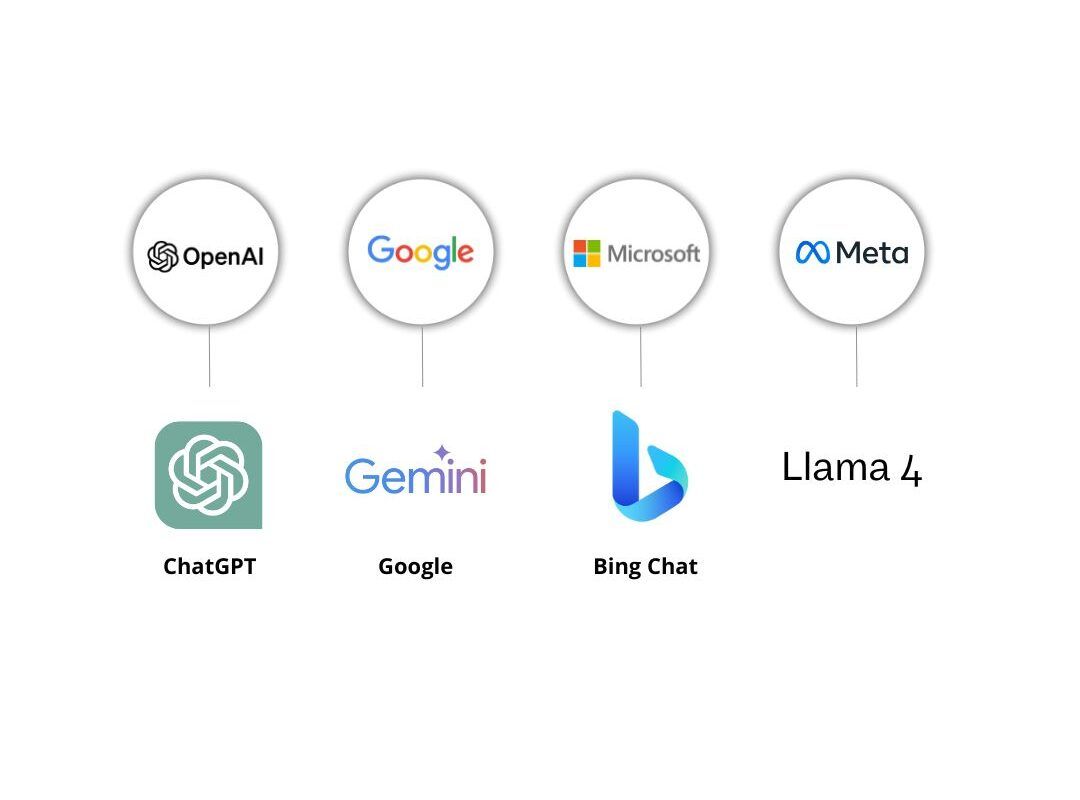
Examples of LLM:
- ChatGPT (OpenAI)
- Bard / Gemini (Google)
- Flame (Goal)
- Bing Chat (Microsoft)
Relevance to your SEO strategy
If the content of your website lacks semantic clarity or does not support specific reasoning steps, it will not be selected, even if it ranks highly in classic organic results (for keywords in Google).
In this AI-driven environment, visibility depends on content engineeringnot just keyword optimisation. You are no longer optimising for a query, but for a matrix of invisible queries interpreted through AI reasoning engines and retrieved probabilistically.
If you content is not optimised for a system such as ChatGPT or IModewill not be part of the answers given by these new search engines and you will be able to you will be missing out on reaching users who are already using these AI technologies. (ChatGPT, Gemini, Copilot, etc) in their day-to-day work.
SEO and AI checklist: indexing, content and authority to boost your website
In order for an LLM to be able to crawl your website and extract information, you need to meet the following requirements.
Indexing and crawling
- Understand that Google and ChatGPT are based on training data, however, they redispatch fresh content on real time through live retrieval to improve the relevance and timeliness of the responses generated.
- Make sure your website is indexed in Bing. Because ChatGPT connects to the web in real time and uses the Bing index and other sources to show updated results with links to the sources.
- Make sure your web pages are eligible for retrieval while maintaining indexing, and the content is very clear. Use current web development technology and a good server that offers a fast website to users.
- Include concise answers within each paragraph for better retrieval of the content by the reader. LLMs.
Quality of content
- Avoid relying on outdated, generic, or thin content that cannot be tracked by AI bots. Update it with new data.
- Produce in-depth, engaging and informative content that directly addresses users' queries and provides high-value information.
- Develop in-depth content topics around key areas or themes of your services.
- Align your content with known entity relationships and Google's understanding of your domain.
- Use entity-rich language and synonyms that reflect users' questions and concerns
Semantic optimisation and NLP
- Ensures content responses to real questions from users.
- Align each page with a clear consultation intent (informational, explanatory, commercial, etc.).
- Use tools to help analyse semantic relevance and NLP to eliminate content gaps.
- Think of every page you create as potential content for semantic footprint development at scale.
Structure and usability
- Breaking up the content into structured sections with H2 and H3
- Use internal links to connect related content and reinforce the user experience.
- Make sure that the AI trackers understand the core semantic intent of each page of your website.
- Create pages that explain your services in depth.
Updating and maintenance
- Regularly review and update content to maintain accuracy and relevance for AI-driven search ranking.
- Update old blog content to reflect current best practices and terms in your industry.
Authority and trust
- Adding clear authorship within your sector with newspaper quotes or have the brand mentioned in high-impact media.
- Ensuring that content is legal, documentary or from authoritative sources reflects real-world experience.
- It includes frequently asked questions that reflect the questions of real customers.