

The aesthetic medicine, wellness and health businesses are facing a radical transformation in how Google perceives, ranks and displays them in search results. Gone are the days when it was enough to appear at the top of Google's rankings; today the Google's artificial intelligence (AI) truly assess who you are, what you do and whether you can be trusted by real patients..
At Eiji Group we have seen different real cases in this health and wellness sector, so in this article we will see:
✅ How Google interprets and values your business
✅ Which signals are most important
✅ How to structure authentic and secure content
✅ Key tables, graphs and metrics
Practical step-by-step solutions
Why does Google AI matter for your business in 2026?
With the advent of AI integrated into Google's algorithm, it is already it is not enough to optimise for keywords. AI looks at signals that were previously insignificant or unused - especially in niche markets. health, aesthetics and well-being, which fall into the category of “YMYL” (Your Money or Your Life) searches, i.e. decisions that affect people's health, money or safety.
This means that Google is not only assessing whether your content mention a keyword, if not, whether it is possible trusting your business as a real provider of health or beauty services.
How Google's AI Evaluates Your Business
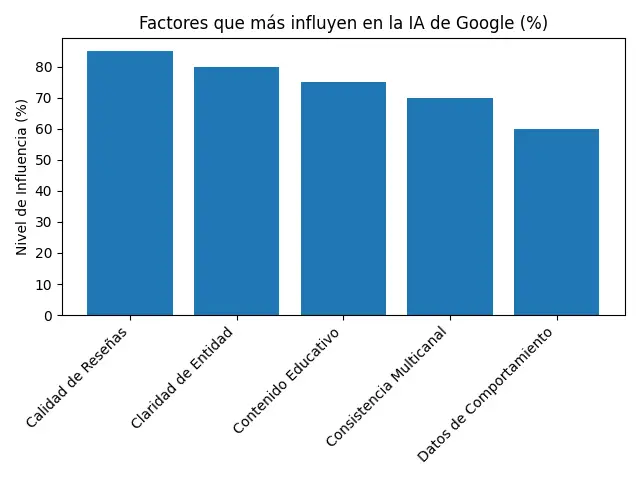
The AI Google takes multiple signals - some traditional and some new - to decide whether to recommend or showcase your business. The following table summarises the main areas of assessment:
| Evaluation Area | What is AI looking for? | Why Does It Matter? |
|---|---|---|
| Entity Clarity | Name, location, services, specialities | AI must know who you are |
| Signs of Confidence | Accurate reviews, specific language, credentials | Indicates legitimacy and security |
| Quality Content | Complete answers with clear intent | Avoid misinformation |
| Behavioural Data | Clicks, calls, bookings | It shows that people they really choose you |
| Cross-platform consistency | GPT, local profiles, websites, blogs | Reduce contradictions about what you do |
1. Clarity of entity: “Who you are” should be obvious.
For AI, the first thing is understand exactly what kind of business you are, what services you offer and how you do it. This clarity is built with signals consisting of:
📍 Legal name of the business
📍 Physical address and areas served
📍 Precise categories in the Google Business Profile
📍 Well-structured service page
📍 Provider biographies and credentials
⚠️ Yes Google not sure what you are doing or who you are doing it for, will not show up in relevant searches even if you are “ranked” with traditional SEO.
Practical example:
If your clinic does “botulinum toxin”and “dermal fillers”, you should have separate pages for each with clear descriptions, benefits, risks, frequently asked questions and who performs it. This level of detail helps the AI differentiate each service and understand your specialisation.
2. Signs of trust: beyond the stars ⭐⭐⭐⭐⭐
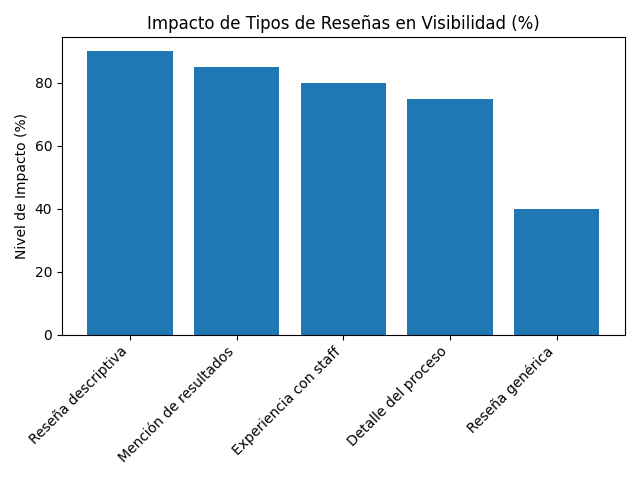
For Google, the reviews are not just stars; This is linguistic data used by AI to “learn” about your business.
What kind of reviews does AI favour?
| Type of Review | Example | Why does it matter? |
|---|---|---|
| Descriptive with treatment | “I had microneedling with Ana and it was excellent”.” | AI identifies what is on offer |
| Mention of results | “My scar improved by 70% in 3 sessions”.” | It points to real results |
| Experience with staff | “The staff was friendly and explained everything”.” | Indicates positive human experience |
| Location / process detail | “Arrived on time, 45 min. treatment...” | Real and coherent context |
Relevant fact: Reviews that include terms such as type of service, outcome, or patient experience outweigh generic reviews as “very good” or “recommended”.
3. Content with intent: Complete, clear and safe
Google no longer rewards only the length of a text; it rewards the quality and intention behind the content. Specifically:
✔ Clear explanations
✔ Realistic expectations
✔ Risks and benefits
✔ For whom is the treatment suitable?
✔ Estimated cost / influencing factors
Advertising-only or generic content tends to diminish trust. and reduce your visibility with AI.
Conceptual graph: Factors most influencing AI for recommendations
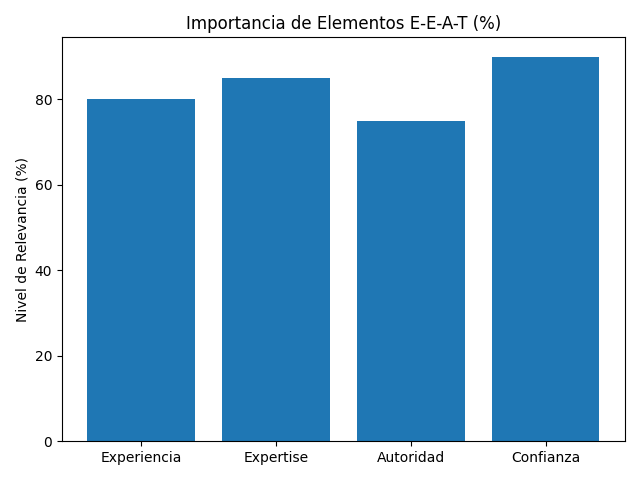
4. E-E-A-T: Experience, Expertise, Authority and Trust (Not just SEO)
This concept, very popular in SEO, becomes more real with AI. The AI does not see E-A-T as a checklist, but as a pattern in these elements:
📌 Experience: content that shows real results
📌 Expertise: author with real credentials
📌 Authority (Authoritativeness): reliable external mentions
📌 Trustworthiness: transparency, detailed reviews
If your site, your business profile, your reviews or your publications say different or contradictory things, AI se become cautious and can hide in the results.
Practical step-by-step strategies
1. Optimise your Business Profile
✔ Make sure you have accurate categories.
✔ Keep NAP (name, address, phone number) consistent.
✔ Upload real photos of treatments, people and results.
✔ Post updates and responses to reviews
Action points:
-
Add services one by one with clear descriptions
-
Include special opening hours, accessibility
-
Integrates automatic response system to frequently asked questions
Profile optimisation is particularly relevant for local searches and to ensure that AI use it as a first “confidence filter”.
2. Collect Detailed Reviews
Ask your patients to mention what they had done, what the process was like and what results they obtained.
✔ Respond to all the reviews, even the refusals (with professional and respectful responses).
Case study:
A clinic that went from 1-2 reviews per month to 11-14 monthly reviews improved its local ranking and visibility significantly, according to local SEO studies.
3. Create Educational Content with Intention
Include on your site:
📍 Detailed pages per treatment
📍 Actual Frequently Asked Questions (FAQs)
📍 Articles explaining risks, expectations, processes
📍 Post-treatment indications
The aim is to educating rather than selling.
Myths vs Reality in AI SEO for clinics
| Common Myth | Reality |
|---|---|
| “More keywords = better ranking”.” | AI prioritises intent and quality |
| “Only technical SEO is needed”.” | Semantic coherence and human cues weigh more heavily |
| “Reviews are just stars”.” | It is data that feeds AI models |
| “Posting lots of blogs helps”.” | Only if they are useful and answer real questions |
Local Marketing Trends 2026
✔ Increase in zero-click searches and AI recommendations
✔ Use of micro-influencers for authenticity
✔ AI to generate structured and secure content
✔ Collection of first-party data
✔ Integration of GEO to appear in AI responses
Recommended tools
📌 Tools for reviews
📌 Local profile management platforms
📌 Schema plugins for data structuring
📌 Medical and Treatment Scheme Generators
Conclusion: AI looks for trust, not just SEO
In 2026, Google's AI does not reward the one who does the most marketing, but the one who generates clarity, transparency and real evidence. Businesses that adapt their strategy to human factors - such as detailed reviews, educational content and consistency in all their data - will gain the most visibility and conversions.
If you want to know the health of your brand at a local level, request a local SEO audit.
Do you want to know how to improve your visibility in search results? Contact Eiji Group